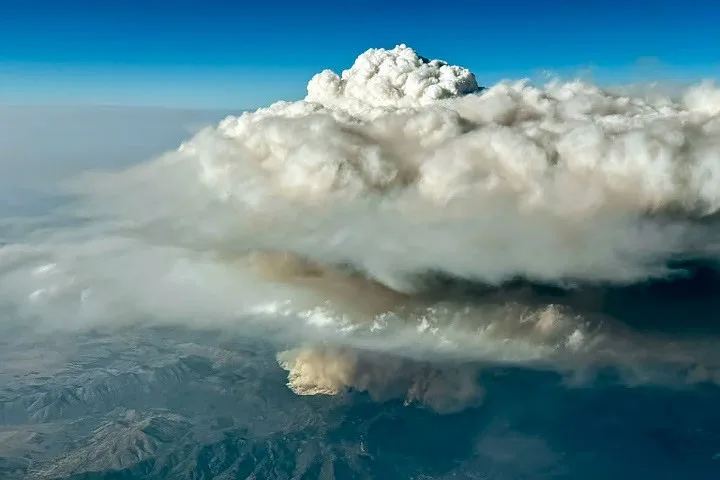
A team of NASA atmospheric scientists, part of the INSPYRE (INjected Smoke and PYRocumulonimbus Experiment) mission, spent the summer chasing some of the most imposing and enigmatic clouds in the sky: pyrocumulonimbus (pyroCb). These towers of smoke and fire, born from wildfires, can reach the stratosphere and alter the planet's climate balance for months or even years.
The Widemouth 2 Fire: A Natural Laboratory in Utah
On August 3, 2026, the team completed one of its first summer sampling missions. The NSF/NCAR GV aircraft, stationed in Colorado, rushed toward a high-altitude smoke column from the Widemouth 2 fire, one of the largest recorded in Utah this year. The fire, started by lightning on July 27, more than doubled in size on August 2 due to strong winds and hot, dry conditions.
That same afternoon, after producing two pyrocumulonimbus eruptions, the MODIS instrument aboard NASA's Aqua satellite captured striking images: a chimney of high-altitude clouds casting its shadow over the low-altitude smoke. Brightness temperatures at the cloud tops dropped well below -40 °C, the usual threshold for identifying these phenomena.
Two PyroCb Activity Pulses
According to Michael Fromm, a scientist at the U.S. Naval Research Laboratory, the measurements reveal "two discrete pulses of pyroCb action." The westernmost, the youngest, stands out in visible images due to the shadow it casts. Interestingly, this episode followed a prior pyrocumulonimbus formed before dawn, unusual since these events typically require daytime heating.
Why These Cloud-Forming Fires Are So Dangerous
Pyrocumulonimbi are true weather factories: they generate lightning, hail, and torrential rains, and can launch enormous amounts of particles and gases into the stratosphere. Once there, the smoke expands widely and can:
- Persist for months or years.
- Circle the entire planet.
- Influence the ozone layer.
- Alter Earth's energy balance.
Although remote sensing experts study these phenomena from satellites, it's less common for pilots to chase them and sample them in situ, just hours after their formation. The GV aircraft collected data at approximately 12 kilometers altitude, an altitude rarely incorporated into prediction models.
Key Pyrocumulonimbus Statistics
Since they first appeared in the scientific literature in the early 2000s, more than 700 events have been cataloged. Satellites have enabled estimates that wildfires generate approximately 70 pyroCb per year, many in the dense forests of Canada and Russia, although they are also abundant in the grasslands and savannas of the U.S. and Australia. In 2026 alone, Fromm and colleagues have identified at least 13 in the continental United States.
The frequency of these events suggests that the total mass of particles they inject during a fire season could rival that of major volcanic eruptions. It is estimated that wildfires contribute up to 25% of black carbon and organic aerosols present in the lower stratosphere.
Unanswered Questions
Despite advances, scientists still do not fully understand these phenomena. Questions remain, such as:
- What type of vegetation most favors pyroCb formation?
- Why do some generate more lightning than others?
- Why do they form in only a small fraction of wildfires?
- How can we predict them accurately?
"Whether through their dangerous manifestations on the ground or their lasting imprint on the upper troposphere and lower stratosphere, pyroCb never cease to surprise us," concludes Fromm.
The Role of the INSPYRE Mission
The mission, led by NASA with support from other agencies, aims precisely to reduce uncertainty for forecasters. As David Peterson, INSPYRE's principal investigator, notes, multiple pyroCb in a single day add complexity to fighting fire and organizing evacuations. "Minimizing that uncertainty for fire forecasters is one of the main reasons we are here studying this," he states.
With Utah's 2026 fire season reaching historic levels, the research is more urgent than ever. NASA's ER-2 aircraft, along with the GV and a network of mobile sensors, will continue chasing these "dirty storms" to decipher their secrets and, ultimately, better protect communities threatened by fire.
Original source: NASA Technology
Comments
No approved comments yet. Be the first to share your thoughts.